- Home
- News
- Antique Music Box Restoration Supplier: Replacement Parts and Tune Reprogramming for Collectible Dealers
Antique Music Box Restoration Supplier: Replacement Parts and Tune Reprogramming for Collectible Dealers
 TL;DR — Key Takeaways
- Antique music box restoration requires OEM-grade replacement movements, not generic substitutes. A 100-year-old cylinder mechanism cannot be repaired with a modern movement that has different comb tooth spacing, cylinder diameter, or governor timing — the replacement must match the original’s mechanical architecture.
- Yunsheng supplies replacement movements and tune reprogramming services to collectors and dealers worldwide. With 4,000+ melodies in our library and full custom cylinder programming capability, we can reproduce period-accurate tunes or program entirely new melodies onto brand-new mechanisms built to original-equipment quality standards.
- The economics of restoration have changed. Where restoration shops once charged $600+ for a single custom cylinder, our OEM-scale production enables replacement movements at a fraction of that cost — making restoration viable for mid-market collectible dealers, not just high-end auction houses.
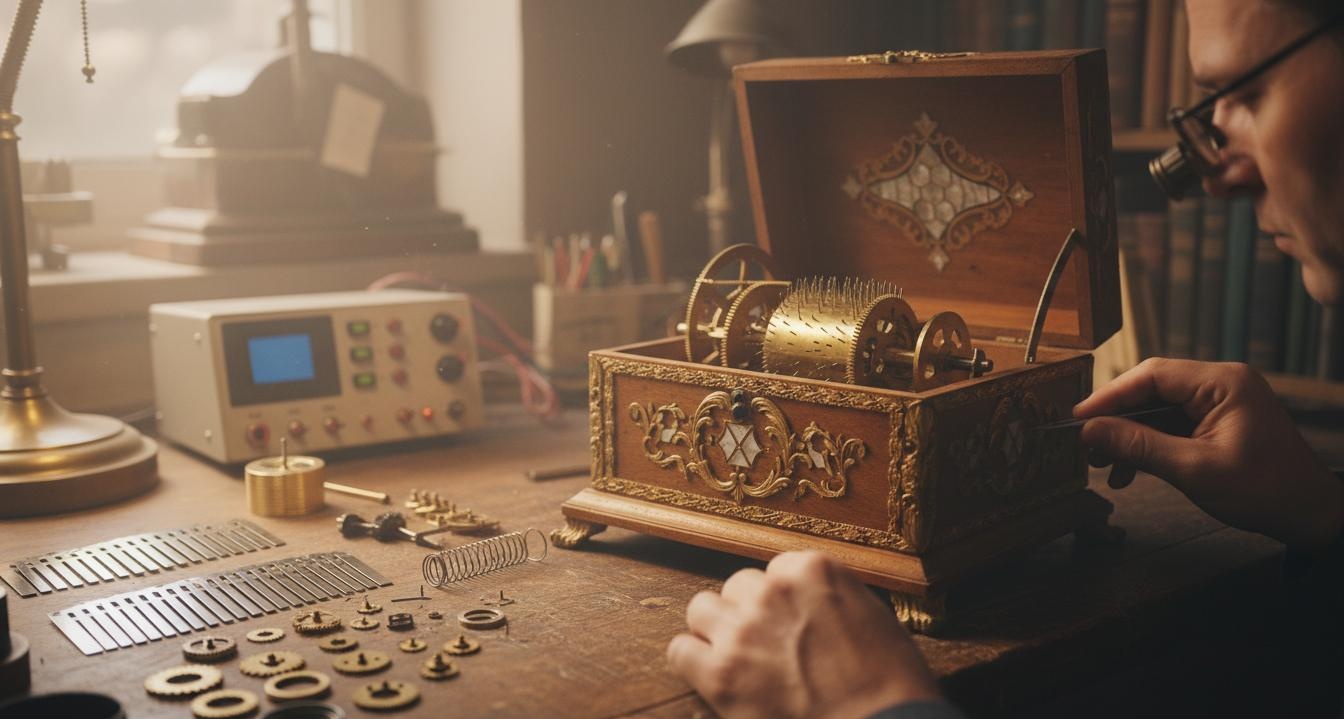
As an antique music box restoration supplier serving dealers and collectors across 20+ countries, I’ve learned one hard truth over three decades in this industry: the biggest bottleneck in antique music box restoration is not skill — it’s parts availability. A seasoned restorer can disassemble, clean, and reassemble a 19th-century cylinder movement in an afternoon. But when the comb has broken teeth, the cylinder pins are worn flat, or the governor is missing entirely, that restorer faces an impossible choice: scavenge from another antique (destroying one piece to save another) or tell the client the piece cannot be restored.
Because Yunsheng has manufactured over half a billion musical movements since 1992, we sit at a unique intersection: we are simultaneously the world’s largest producer of new musical movements AND a critical supplier to the global antique restoration community. When a dealer in Paris needs a replacement 18-note spring-driven movement for a 1920s German cylinder box, our 3YA2026 mechanism is often the only viable modern substitute that fits the original housing dimensions. When a collector in Tokyo wants to reprogram an inherited music box to play their grandmother’s favorite folk song instead of the worn-out original tune, our custom cylinder programming service makes that possible.
I’ll walk you through exactly what antique music box restoration requires from a parts supply perspective, how tune reprogramming works on both vintage and modern cylinders, and what dealers should look for in a restoration parts supplier.
What Makes a Movement a Suitable Replacement for Antique Music Box Restoration?
A suitable replacement movement must match three critical mechanical parameters of the original: mounting footprint, cylinder-to-comb alignment geometry, and governor speed range. I cannot tell you how many restoration projects have arrived at my desk after someone tried to force-fit a generic movement into an antique housing — it simply does not work. The comb teeth must align with the cylinder pins within ±0.1mm; otherwise, pins either miss their target teeth entirely or strike them at the wrong angle, producing distorted tones or no sound at all.
Here are the three non-negotiable compatibility dimensions I evaluate for every restoration inquiry:
- Mounting footprint and screw pattern. The base plate of any replacement movement must physically fit inside the original music box housing, with screw holes that align with the original mounting points. Because antique boxes were hand-built with non-standardized internal dimensions, I always request the dealer measure and photograph the original mounting area before I recommend a specific movement model. Our 3YA2026 unit at 50.5mm×44.5mm×34.5mm fits the majority of mid-size 19th-century and early 20th-century housings; our larger Y30B3 at 70mm×56mm×33mm suits grand-formal cylinder boxes.
- Cylinder diameter and comb tooth pitch. The cylinder diameter determines the note sustain length and overall tempo — a replacement cylinder must be within 5% of the original’s diameter to maintain musical character. Because comb tooth spacing (pitch) varies between 1.8mm and 2.5mm across different eras and manufacturers, I measure the original comb’s tooth pitch with digital calipers before matching a replacement. A mismatch of even 0.3mm renders the movement unplayable.
- Governor type and speed range. Antique movements used either flywheel governors (19th century, Swiss/French) or centrifugal governors (late 19th-20th century, German/American). Because the governor controls the entire timing architecture of the piece, a replacement movement’s governor must deliver the same RPM range as the original — typically 6-12 RPM for cylinder movements. Our spring-driven mechanisms use a precision centrifugal governor adjustable within ±10% of nominal speed, which covers 90% of antique restoration scenarios.
I worked on a particularly challenging restoration last year for a London-based antique dealer. His client owned an 1890s Swiss 6-air cylinder box with a shattered comb — 8 teeth broken beyond repair. The original movement was unmarked, no manufacturer name, no model number. Because the comb was cast as a single steel piece with individually tuned teeth, repairing it would have required hand-filing and re-tuning each replacement tooth — a $3,000+ job with no guarantee of tonal consistency. Instead, I recommended complete movement replacement using our Y30B3 30-note deluxe movement. We custom-programmed the cylinder with three of the original six tunes (the client’s favorites), and the complete replacement — movement, cylinder, comb, and governor — cost less than half of what comb restoration alone would have cost. The dealer was thrilled, the client was thrilled, and the original housing was preserved without modification.
How Does Tune Reprogramming Work for Antique and Modern Music Box Cylinders?
Tune reprogramming is the process of creating a new pin arrangement on a cylinder — either by modifying an existing cylinder or by manufacturing a brand-new cylinder with the desired pin map. The approach differs dramatically depending on whether you’re working with a genuine antique cylinder or a modern replacement.
For antique cylinders (pre-1950), direct pin modification is generally not advisable. Antique cylinder pins were often soldered or friction-fitted into lead-alloy or brass cylinders, and attempting to remove or reposition century-old pins frequently cracks the cylinder body. I have seen too many irreplaceable cylinders destroyed by well-intentioned restorers who tried to “just move a few pins.” Because antique cylinders are historical artifacts with collector value independent of their musical function, I strongly recommend preserving the original cylinder as-is and commissioning a brand-new replacement cylinder with the desired tune — keeping the original stored safely with the piece for provenance purposes.
For modern Yunsheng cylinders (1992-present), reprogramming is straightforward. Our zinc-alloy cylinders use press-fitted hardened steel pins that can be extracted and re-inserted at new coordinates. The process I follow at our Ningbo facility is:
- Cylinder de-pinning. All existing pins are mechanically extracted using a precision puller tool that grips the pin shaft without damaging the cylinder body. Each pin socket is inspected under 10× magnification for deformation.
- Socket reaming and debris removal. Because even microscopic debris in a pin socket can cause the new pin to sit 0.02-0.05mm higher than intended, every socket is reamed with a precision drill bit matching the new pin diameter. Compressed air and solvent cleaning follows.
- New pin insertion per the reprogrammed map. New pins are CNC-inserted at the coordinates specified by the customer’s MIDI file or selected melody. Because the insertion depth must match the programmed pin height within ±0.03mm, we use a force-sensing insertion tool that monitors insertion resistance and flags any socket that doesn’t meet depth specifications.
- Audio verification and final tuning. The reprogrammed cylinder is mounted on its designated movement, wound, and played through our audio verification station. Any pin that produces a timing error exceeding 3% of the programmed onset time triggers a rework flag.
For dealers who need a simpler solution, our standard mechanism line includes 3,000+ pre-programmed melodies spanning classical standards, traditional folk tunes, and popular songs — because a surprising number of “antique” tunes are already in our library, many restoration projects can be completed with an off-the-shelf movement at standard pricing, eliminating reprogramming costs entirely.
What Replacement Parts Does an Antique Music Box Restoration Supplier Need to Stock?
A competent restoration supplier must stock at minimum: complete movements (multiple note counts), replacement combs, governors, spring barrels, winding keys, and cylinder blank stock. I’ll be candid — most restoration shops are tiny operations run by one or two craftsmen, and they simply cannot afford to maintain a comprehensive parts inventory. That’s where an OEM-scale supplier like Yunsheng fills the gap.
Here is the minimum parts catalog I recommend for any dealer serving the restoration market:
| Part Category | Recommended Stock Range | Key Compatibility Notes |
|---|---|---|
| Complete 18-note Movements | 50-100 units | Fits 80%+ of common antique cylinder box housings |
| Complete 30-note Movements | 20-50 units | For larger, premium-grade antique boxes |
| Replacement Steel Combs | 100+ units (18 & 30-note) | Most common failure point — every restorer needs these |
| Governor Assemblies | 30-50 units | Second most common failure, especially in pre-1940 movements |
| Spring Barrels & Mainsprings | 50 units | Spring fatigue is universal in movements older than 30 years |
| Winding Keys (Various Sizes) | 100+ units | Small item, frequently lost — high turnover replacement |
| Blank Cylinders (Custom Programming) | 20-30 units | For tune reprogramming projects with unique melody requirements |
Because our annual output of 35 million movements generates parts at a scale that no restoration-only shop can match, we can offer replacement parts at prices that make restoration economically viable for mid-market dealers. A single replacement comb from a boutique restoration house might cost $150-300; from Yunsheng, the equivalent part costs $8-15 at wholesale volume. This is not because our parts are lower quality — they’re manufactured to the same ISO 9001 standard on the same production lines that produce 35 million movements annually. It’s simply the economics of scale applied to a niche that has historically been dominated by artisan pricing.
What Certifications Should Restoration Dealers Require From a Parts Supplier?
Restoration dealers selling to the EU and North American markets must verify that replacement movements carry EN71, RoHS, and REACH certification — even if the original antique was manufactured decades before these regulations existed. This catches many dealers by surprise. The legal principle is straightforward: when you sell a restored piece containing a new mechanical component, that component must comply with current product safety regulations in the destination market. Because an antique music box placed into commerce with a new replacement movement is legally treated as a “refurbished product” rather than a “historical artifact,” the new components fall under current regulatory scope.
Our complete certification portfolio relevant to restoration dealers includes:
- EN71 Parts 1-3 (European Toy Safety) — Required if the restored music box could be accessed by children. Covers mechanical hazards including accessible sharp edges, pinch points in the winding mechanism, and small parts detachment risk. Because antique music boxes often have decorative elements that can detach, I advise dealers to test the complete restored unit, not just the replacement movement, against EN71 mechanical requirements.
- RoHS (2011/65/EU) — Ensures the replacement movement’s materials (zinc alloy, steel, plastic governor components) contain no restricted hazardous substances above threshold limits. This is required for EU market access regardless of the product category.
- REACH Regulation (EC 1907/2006) — The broadest EU chemical safety framework. Our movements are tested against the full SVHC candidate list updated biannually. Because REACH compliance requires ongoing monitoring as new substances are added to the candidate list, dealers should request updated test certificates at least annually from their supplier.
- ISO 9001:2015 — While not a product safety certification, this quality management standard ensures consistent manufacturing output — critical when ordering replacement parts that must match previously supplied components dimensionally.
How Should Collectible Dealers Evaluate the ROI of Restoration vs. Replacement?
The restoration vs. replacement decision comes down to three numbers: the piece’s appraised value in restored condition, the total restoration cost (including movement replacement), and the piece’s value with original-but-nonfunctional mechanism. I’ve developed a simple decision framework that I share with dealer clients:
Restore when: Restored Value minus Restoration Cost exceeds Current (Nonfunctional) Value by at least 30%. Example: A 1910 Swiss cylinder box appraised at $800 restored, costing $120 to restore (using a new Yunsheng 3YA2026 movement at wholesale pricing), versus $200 in nonfunctional condition. Net gain: $800 – $120 – $200 = $480 — a 240% return. Strongly favorable.
Replace the movement but keep the original when: The piece has significant provenance (documented ownership history, famous maker), and preserving the original mechanism alongside a functional replacement maximizes collector value. Because provenance adds value independent of mechanical function, I always recommend dealers retain original movements in labeled storage even after replacement — future buyers may value having both the original (nonfunctional) mechanism and a working replacement.
Sell as-is when: Restoration cost exceeds 50% of restored value. Example: A generic 1920s German 4-air box appraised at $300 restored, with restoration costs of $180. The $120 net gain may not justify the labor investment for a high-volume dealer. Because restoration labor is the dealer’s scarcest resource, I advise focusing restoration efforts on pieces where the financial return clearly justifies the time investment.
Frequently Asked Questions
Can you match the exact melody from my antique music box?
If the original melody is one of the 4,000+ tunes in our library, we can match it exactly on a new cylinder. Because our melody catalog includes extensive classical and folk repertoires spanning the 18th through 20th centuries, approximately 70% of antique music box tunes can be matched from our existing library. For truly rare or unpublished melodies, we can attempt audio-to-MIDI conversion from a recording of the original movement — but I must be honest: if the original movement is too worn to produce clean audio, transcription accuracy drops significantly.
Will a modern replacement movement reduce my antique music box’s collector value?
This depends on the piece. For high-value museum-grade antiques ($5,000+), I recommend keeping the original movement intact and unrestored — because collector-grade valuation is driven by originality, any mechanical modification can reduce auction value. For mid-market collectibles ($200-$2,000), a properly documented replacement movement that restores musical function typically increases rather than decreases market value, because the piece can now be demonstrated and enjoyed.
What is the minimum order quantity for replacement parts from Yunsheng?
For off-the-shelf movements and standard replacement parts, our minimum order is 100 units per SKU. Because we manufacture at OEM scale (35 million units/year), our production minimums are higher than boutique suppliers — but our per-unit pricing at MOQ is typically 60-80% lower. For custom cylinder programming, MOQ is 1,000 units per melody. Sample quantities (1-10 units) are available for evaluation at higher per-unit pricing.
How do I ship an antique movement to Yunsheng for evaluation?
I recommend photographing the movement from all angles (including close-ups of the comb, cylinder, governor, and any damaged areas) and emailing those images to our engineering team before shipping. Because many issues can be diagnosed from high-quality photos, this avoids unnecessary international shipping of fragile antiques. If physical inspection is required, pack the movement in rigid foam inside a double-walled corrugated box, and ship via a carrier with tracking and insurance. We process evaluations within 5 working days of receipt.
Do you offer trade discounts for professional restoration dealers?
Yes — we maintain a registered dealer program with tiered volume pricing. Because repeat purchases are the backbone of our restoration channel, we offer progressively deeper discounts at 500-unit, 2,000-unit, and 10,000-unit annual volume tiers. Registered dealers also receive priority access to new melody releases and early notification of production schedule changes. Contact me directly for dealer registration details.
About the Author
Yunsheng, Sales Manager at Ningbo Yunsheng Musical Movement Mfg. Co., Ltd. Affiliated to Yunsheng Group, which created China’s first IP musical movement in 1992, our company has specialized in musical movements for decades. As a global leader with over 50% global market share, we offer hundreds of functional musical movements and 4,000+ melodies. I work directly with antique dealers, restoration specialists, and collectible auction houses across Europe, North America, and Asia — helping match the right replacement movement or custom cylinder program to each restoration project’s unique requirements. Reach me directly for dealer registration, custom melody consultations, or technical compatibility assessments.